Book list printer
Discuss the information and wording for book list printer, then ask for a link to open and review the result in Python Editor.
 Simple Python / AI Skill
Tell your assistant what you want to make in Python Editor. Discuss the content and refine it together, then open the resulting URL in the app. Paste the instructions URL to get started, or install the Skill for repeat use.
Read the instructions and linked data reference at this URL, and use the URL tool to create content I can open in Python Editor.
https://github.com/y-tanaike/public_skills/blob/main/python/SKILL.md
Help me create Python that prints numbered book categories. Ask questions about missing information and refine the content through conversation. Use English for display text, then return an app-opening URL.
English instructions, your language
Discuss the information and wording for book list printer, then ask for a link to open and review the result in Python Editor.
Discuss the information and wording for loop practice, then ask for a link to open and review the result in Python Editor.
Discuss the information and wording for text formatting, then ask for a link to open and review the result in Python Editor.
YouI want to create Python that prints numbered book categories. Can you help me organize it?
AssistantWhat is the input data, and what output do you want?
YouLet us start with fictional sample details. Please ask if any important information is missing.
Read this instructions URL and its linked reference files, then use the URL tool to create Python that prints numbered book categories in Python Editor. Use the following fictional sample details and English display text. Return an app-opening URL.
https://github.com/y-tanaike/public_skills/blob/main/python/SKILL.md

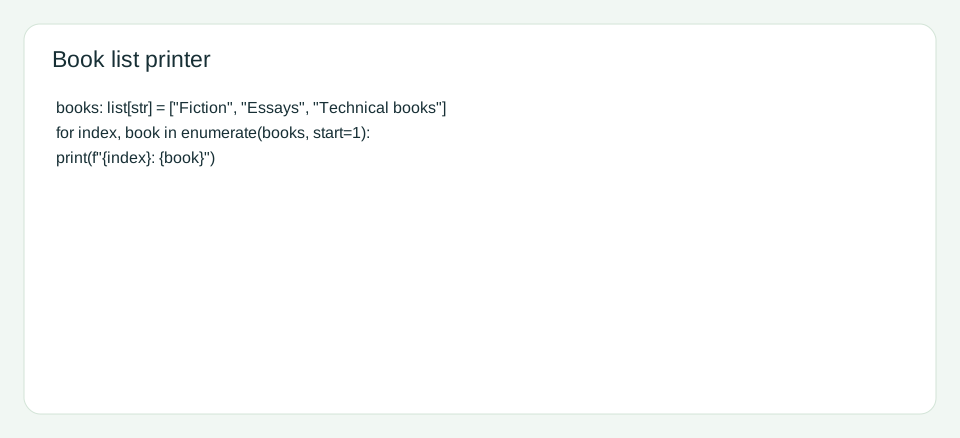
Content / books: list[str] = ["Fiction", "Essays", "Technical books"]
for index, book in enumerate(books, start=1):
    print(f"{index}: {book}")
| Item | Content |
|---|---|
| Content | books: list[str] = ["Fiction", "Essays", "Technical books"] for index, book in enumerate(books, start=1): print(f"{index}: {book}") |
books: list[str] = ["Fiction", "Essays", "Technical books"]
for index, book in enumerate(books, start=1):
    print(f"{index}: {book}")
You can copy the prompt above into your assistant, or open the prepared sample to explore it first.
Open this sample in the appStart with a rough idea. You can ask the assistant to organize it, answer its questions, and refine wording or add details before generating an app-opening URL.
Paste the instructions URL and your request into the prompt, as in the example above. Ask the assistant to read the linked reference and use the URL tool too. You can also paste the instructions themselves. This gives it the same workflow for the current conversation without installing a Skill.
Add the entire python folder, including scripts, references, and examples, to an AI environment that supports Skills. Then ask it to use the python Skill. You no longer need to paste the full instructions or URL each time. Installation depends on the environment.
Use an AI environment that can read external URLs and run Python or equivalent code to generate the link. If it cannot open the URL, provide the instructions and referenced files directly. Pasting a URL alone does not give the assistant browsing or code-execution capabilities.
Use the python Skill to help me create Python that prints numbered book categories. Ask about anything missing and return a URL I can open in Python Editor.
Explain who the content is for and what you want to communicate. The assistant can help identify missing information.
Ask for clearer wording, extra items, or a different structure. Review the content before asking for a new URL.
Open the returned URL in Python Editor, review the preview, and edit the details in the app as needed.
For example, ask for Python that prints numbered book categories. Give any details you already know and discuss the rest as you go.
Answer follow-up questions and ask for changes. When the content is ready, ask the assistant to generate the app-opening URL.
Check the preview in the app. Import it using the available save actions if you want to keep it.
The Skill instructions are in English, but the assistant can respond and create content in your requested language. Both Japanese and English examples are included.
The link opens an unsaved preview. If you want to keep it, import it in the app using the available save options.
Anyone with the URL can recover the content. Leave out information you do not want to share. Split large content if needed; a new URL does not update an earlier link.
The URL opens code for review and editing. URL generation does not prove the code is correct or that it ran successfully.
Yes. Paste the instructions URL and your request into a conversation. The assistant needs to access the reference files and run Python or equivalent code to generate the URL. If it cannot read URLs, provide the files directly.
You can ask the assistant to use the python Skill instead of pasting the full workflow or instructions URL each time. Keep describing what you want and refining it through conversation.
No. The URL opens an unsaved preview. Review it and import it in the app if you want to keep it. Available save actions depend on the environment.
The GitHub folder contains the instructions, URL tool, data reference, and examples. The repository also lists Skills for other apps.